
Best smart trainer for Rouvy: shoes and used vs new bikes
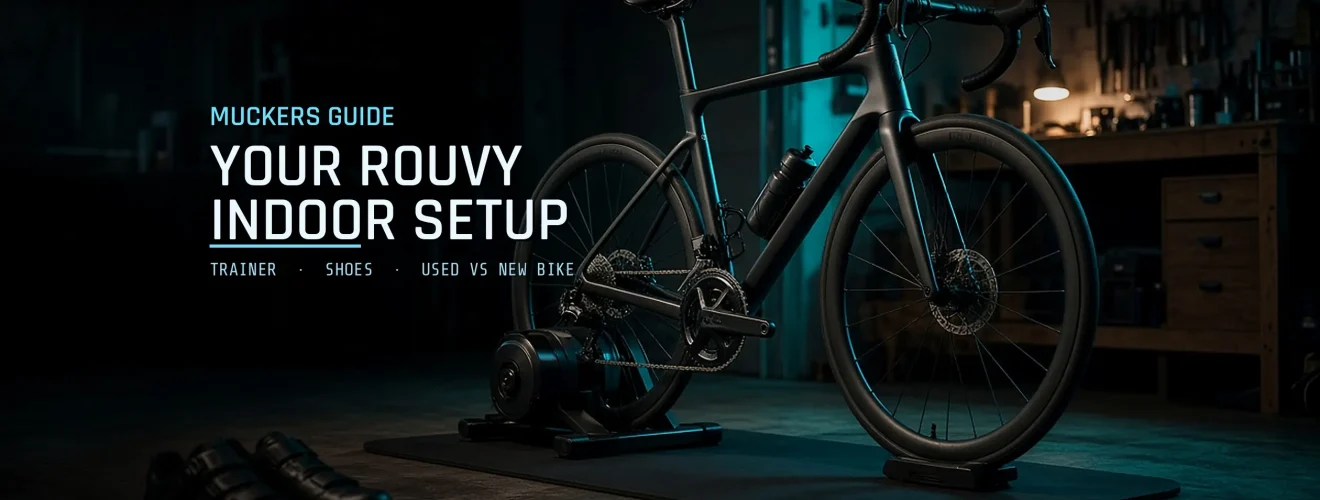
If you want to race with the Muckers this winter, you don’t need a pain cave that looks like a shop window. You need a smart trainer that works with Rouvy, a bike that actually fits it, and a pair of shoes you can clip in and forget about. This UK guide covers the lot: the best smart trainer for Rouvy from budget to mid-range, beginner cycling shoes including wide-fit options, and whether a used bike from Facebook Marketplace or eBay is a better starting point than a new one.
Prices checked on 25 November 2026. *
We’ve only listed trainers that are confirmed to work with Rouvy, and every product link below goes to a retailer page we opened today. Stock and sizes move quickly, especially during the sales, so do check the page before you buy. While the Black Friday deals last, you’ll also find our weekly verified price-drops in the Deals section.
What do you need for a Rouvy indoor setup?
A Rouvy-compatible smart trainer, a bike that fits it, and a pair of clipless shoes.
Three bits of kit do most of the work:
- A smart trainer that Rouvy can talk to, so the app changes the resistance as the road goes up and down.
- A bike that fits the trainer – the right frame size for you, and an axle and cassette the trainer can accept (or a cheap adapter if it doesn’t).
- Shoes and pedals, so you’re clipped in and consistent. Trainers and flats will get you started, but clipless shoes make a long indoor session a lot more pleasant.
If you already have a road or gravel bike, start with the trainer and shoes. If you don’t, read the used-versus-new section before you spend anything: the cheapest way to get riding is often a sensible used bike plus a good trainer, not a brand-new race machine.
What’s the best smart trainer for Rouvy: wheel-on or direct-drive?
For racing and structured training on Rouvy, buy a direct-drive trainer. A wheel-on smart trainer will work, but it is noisier and less accurate.
If you’re choosing a turbo trainer for Rouvy, that is the first decision to make.
What’s the difference?
A wheel-on trainer leaves your rear wheel in; a direct-drive replaces it with the trainer’s cassette.
A wheel-on (or “wheel-on turbo”) trainer clamps your rear axle, and your back tyre presses against a roller. They’re usually lighter, quicker to set up and they work with almost any bike, because you leave the rear wheel in. The trade-offs are familiar to anyone who’s tried one: they’re noisier, they wear the tyre (use a dedicated trainer tyre), the ride feel is less realistic, and you have to set the tyre pressure and roller tension the same every time if you want consistent numbers.
A direct-drive trainer replaces your rear wheel. You take the wheel out and fit the bike straight onto the trainer’s cassette. They’re quieter, more accurate and much more realistic, and they can simulate steeper climbs and bigger sprints. They cost more, they’re heavier, and you need to check the axle standard and cassette (or freehub) will suit your bike. For racing and structured training on Rouvy, a direct-drive is the one we’d buy.
How does Rouvy compatibility work?
Rouvy controls a smart trainer over ANT+ FE-C or Bluetooth FTMS, so the app can change the resistance on climbs.
In plain English: once you have a Rouvy-compatible trainer, the app sends the gradient to it, and the trainer changes the resistance so a climb actually feels like a climb. Some newer trainers also add Wi-Fi. When you add the trainer in Rouvy, choose it as a “Smart trainer” (older app versions called this “Controllable”).
If a trainer only has a speed or power sensor and no FE-C or FTMS, Rouvy can still record the ride, but it can’t control the resistance for you. That’s fine for easy spins; it’s not what you want for a Muckers race. Every trainer we list below is on Rouvy’s official supported list, and each one connects over ANT+ FE-C and Bluetooth. The Wahoo KICKR CORE 2 also has Wi-Fi.
Always check your exact model on Rouvy’s supported trainers page if you’re buying something we haven’t listed, or if you’re using a trainer you already own.
Which smart trainers would we buy for Rouvy?
The Wahoo KICKR CORE 2 at £399.99 is the best-value Rouvy-ready option we found today.
There isn’t a cheap wheel-on smart trainer bargain on our usual UK retailers today. The only wheel-on smart trainer we could verify in stock, the Saris M2, is actually dearer than a better direct-drive. A cheap smart trainer in the UK is, today, a sale-priced direct-drive rather than a wheel-on. So our budget-to-mid-range picks start with direct-drive, which is the right way round for Rouvy.
- Best Value Pick: Wahoo KICKR CORE 2 Power Trainer (Tredz): £399.99, RRP £499.99, save £100 (20%). In stock. This is the one we’d buy for a Rouvy setup. It’s a quiet, accurate direct-drive (Wahoo quotes ±2%, up to 1,800 watts and a 16% simulated grade), it connects over ANT+ FE-C, Bluetooth and Wi-Fi, and it comes with an 11-speed cassette already fitted. Wahoo lists it as fitting 130/135 mm quick-release and 12×142 or 12×148 thru-axles, with adapters included, and it’s compatible with 8- to 13-speed Shimano HG drivetrains (SRAM XD/XDR or Campagnolo need a different freehub; the stock cassette isn’t right for Shimano CUES/LinkGlide). It’s a Rouvy recommended trainer, including official support for virtual shifting on the CORE 2.
- Saris M2 Wheel On Smart Turbo Trainer (Leisure Lakes): £429.99. In stock. A proper wheel-on smart trainer, with ANT+ FE-C and Bluetooth, integrated speed, cadence and power (±5%), and up to 1,500 watts and a 15% climbing grade. It’s on Rouvy’s supported list (as Saris Magnus/M2). If you need to swap the bike on and off the trainer every day and you really don’t want to pull a rear wheel, this is the in-stock option. For most Muckers, though, the CORE 2 at £399.99 is quieter, more accurate and cheaper, so that’s the better buy.
- Tacx Neo 2T Smart Trainer (Tredz): £699, RRP £859.99, save £160.99 (19%). In stock, and the same price at Leisure Lakes. If you want to spend a bit more and get a long-time Muckers favourite, this is the mid-range step-up: very quiet, realistic ride feel, up to 2,200 watts and a 25% simulated grade, with ±1% power accuracy, ANT+ and Bluetooth. It’s a Rouvy recommended trainer. Worth it if winter is when you do your serious training and you want the trainer to disappear underneath you.
Muckers verdict: buy the KICKR CORE 2 unless you already know you need a wheel-on. At £399.99 it’s the best-value Rouvy-ready direct-drive we can find today, and it’s the trainer we’d put in our own spare room.
Which beginner cycling shoes and cleats work for indoor riding?
A comfortable clipless beginner shoe that matches the pedals on your turbo bike. SPD is easier to walk in; SPD-SL matches most road bikes.
You can ride Rouvy in trainers, but after half an hour you’ll wish you hadn’t. Clipless shoes keep your foot planted, make your pedal stroke more consistent and stop you sliding off the pedal in a sprint. For indoor riding you want a comfortable beginner shoe, not a stiff race slipper you’ll only wear twice.
Should you choose SPD or SPD-SL for indoor riding?
Choose the system that already matches your pedals. If you’re starting from scratch, SPD is the more practical everyday option.
SPD (Shimano’s two-bolt mountain-bike system) uses a smaller recessed cleat. The shoes are easier to walk in, which matters if your trainer lives upstairs, and they’re more forgiving when you’re learning to clip in and out. Plenty of Muckers race in SPD, and it’s the more practical choice if you’ll also commute or ride gravel on the same shoes.
SPD-SL is the three-bolt road system, with a larger cleat and a bigger platform. Power transfer is slightly better and the float (how much your heel can wiggle) is easy to set, but the cleats are slippery on kitchen tiles and they wear down if you walk on them. If your indoor bike already has road pedals, or you only ever ride a road bike, SPD-SL is the usual match.
Pick the system that matches the pedals on the bike you’ll put on the trainer. Don’t buy road shoes for SPD pedals, or the other way around, unless the shoe is specifically made for both.
How should you set up your cleats?
Put the centre of the cleat under the ball of your foot, start with the cleat straight, and make only small changes after an easy session.
A bad cleat position is the fastest way to annoy your knees. A simple starting point:
- Put the shoe on and mark the ball of your foot on the side of the sole. The cleat’s centre should sit under that mark, or just behind it.
- Start with the cleat straight, not toed in or out. SPD-SL yellow Shimano SM-SH11 cleats (Tredz: £8.99, RRP £21.99, in stock) have 6 degrees of float, which is the forgiving option for beginners. The fixed red SM-SH10 cleats are best left until you know what you need.
- For SPD, the Shimano SH51 cleats (Tredz: £7, RRP £19.99, in stock) are the standard single-release version. SH56 multi-release cleats are easier to twist out of in a hurry.
- Do up the bolts firmly, ride an easy session, then tweak. If the inside of your knee niggles, try a millimetre or two of rotation. Small changes, one at a time.
- On a turbo, unclip before you stop pedalling. There’s no track to put a foot down, and a standing fall onto the sitting-room carpet is a rite of passage we’d rather you skipped.
Which beginner and wide-fit cycling shoes should you buy?
The Shimano XC1 (SPD) or RC1 (SPD-SL) will do the job for most beginners. If you need a wide last, start with the Northwave Sonic Plus Wide if your size is in stock.
- Best Value Pick (SPD): Shimano XC1 (XC102) MTB Cycling Shoes (Tredz): from £66.99, RRP £79.99. A straightforward two-bolt beginner shoe, with most sizes from EU 40 to 50 in the warehouse today at £66.99; EU 38, 39 and 47 are listed at £79.99. If you want one pair for the turbo and the towpath, start here.
- Best Value Pick (SPD-SL): Shimano RC1 (RC102) Road Cycling Shoes (Tredz): from £69.99, RRP £79.99. The standard entry-level road shoe, with a wide size run. Most black and navy sizes from EU 36 to 47 are £69.99 and in the warehouse; EU 41 black is £79.99, and EU 48 is on a long pre-order.
- Specialized Torch 1.0 Road Shoes (Cyclestore): from £69.99, was £99. A roomier beginner road shoe than some race lasts, with sizes from EU 36 to 48 in stock in at least one colour. £69.99 is for black in EU 40; a few other sizes are in the mid-£70s, and most of the range is £87.95 to £87.99. A good option if the RC1 doesn’t feel right on your foot.
- Shimano IC1 (IC100) Indoor Cycling Shoes (Tredz): £79.99. Built for indoor riding and compatible with both SPD and SPD-SL, which is handy if you haven’t chosen a pedal system yet. EU 36, 38–41, 44–47, 49 and 50 are listed; a few common sizes (including 42 and 43) aren’t showing today, so check before you get your hopes up.
If you’ve got wide feet, don’t just size up a standard shoe – you’ll end up with a boot that’s long and still tight across the toes. Look for a model that’s actually sold as wide:
- Northwave Sonic Plus Wide Fit Road Cycling Shoes (Tredz): £84.99, RRP £99.99. SPD-SL, and the cheapest dedicated wide road shoe we found in stock. Sizes are limited today: EU 41 and 42 in white/black, plus 41, 44, 45 and 46 in black/light grey, all in the warehouse.
- Shimano RC3 (RC302) Wide Fit Road Cycling Shoes (Tredz): from £99.99, RRP £129.99. A step up from the RC1, in a proper wide last. EU 42 is £99.99 and in the warehouse; 43, 44 and 46 are £104.99; some of the larger sizes are on pre-order into 2027, and there are no EU 36–41 listed, so this one is better if you take a larger size.
- Fizik Vento Omna Wide Fit Road Shoes (Cyclestore): from £99.99, was £149.99. The widest size run of the wide shoes we checked: most sizes from EU 36 to 48 are in stock. £99.99 is for black in EU 39; a few sizes are £109.99, and most of the range is £129.99.
- Shimano XC3 (XC302) Wide Fit Off-Road Shoes (Tredz): from £104.99, RRP £129.99. The wide SPD option. EU 40, 42, 43 and 44 are available from £104.99 (43 and 44 have later due dates on the page); 41 is £109.99; 45 and up are out of stock or on a long pre-order.
Muckers verdict: SPD in the XC1, or SPD-SL in the RC1, will do the job for most beginners. If you need a wide last and your size is there, the Northwave Sonic Plus Wide is the value pick, and the Fizik Omna Wide has the sizes the others are missing.
Should you buy a used or new bike for the turbo?
A carefully checked used bike can be a great turbo bike, but a new Boardman SLR 8.6 at £520 often beats a vague used listing if your size is in stock.
You do not need a new bike to ride Rouvy. Plenty of Muckers race on a winter hack or a used road bike that never sees a wet Sunday club run. A used bike from Facebook Marketplace or eBay can be a great turbo bike. It can also be a very expensive way to buy someone else’s problems. Here’s how to decide.
When does a used bike make sense?
When you can confirm the size, axle and condition, and you’re not being rushed into a payment.
A used aluminium road or gravel bike, in your size, with a serviceable groupset, is often a lot of bike for a lot less than the new equivalent. That’s especially true if you only need it for the trainer: scratches, faded bar tape and a slightly scuffed wheelset barely matter when the bike is bolted down in the spare room. Buy used if you can inspect it (or get clear, recent photos and a video of it changing gear), the frame size is right, and the axle and cassette will work with your trainer – or you’ve budgeted for a simple adapter.
We’re not going to invent typical asking prices. What a used Boardman, Specialized Allez or Giant Contend goes for depends on the year, the groupset, the condition and how patient the seller is, and it changes week to week. Look at several sold or completed listings for the same model, not just the one optimistic advert, and be wary of anything far below the rest.
How do you get the frame size right?
Use the manufacturer’s size chart for that model, plus your height and inseam — not a guess that the seller is “about your height”.
Get the size right. A turbo doesn’t forgive a bike that’s too small or too stretched, because you can’t sit up and soft-pedal around a corner. Ask for the frame size (S/M/L or the seat-tube/reach figures), your own height and inseam, and compare them with the manufacturer’s size chart for that model. If you can sit on it, check you can hold the hoods with a slight bend in the elbow, and that you aren’t rocking your hips at the bottom of the stroke.
What’s the difference between a quick-release and a thru-axle?
A quick-release is a 5 mm skewer, usually 130 or 135 mm; a thru-axle is typically a 12 mm axle, most often 12×142 mm on modern road bikes.
This is the bit that catches people out. The trainer has to clamp the rear dropout, and bikes use two different standards:
- Quick-release (QR): a 5 mm skewer through a 130 mm (road) or 135 mm (many older hybrid and mountain) dropout. Most older road bikes, and plenty of budget ones, still use QR.
- Thru-axle: a 12 mm axle, most often 12×142 mm on modern road and endurance bikes, or 12×148 mm “Boost” on some gravel and mountain bikes. The thread pitch can vary (1.0, 1.5 or 1.75 mm are all out there), so “it’s a 12 mm axle” isn’t quite enough information.
The KICKR CORE 2 is a helpful example: Wahoo says it fits 130/135 mm QR and 12×142 or 12×148 thru-axles, and includes the adapters. Other trainers are less generous. If the bike is a thru-axle and the trainer isn’t, you need the right adapter (end caps or a trainer-specific thru-axle), not a hopeful wiggle. Elite, Tacx and Wahoo all sell official adapters; a generic one is fine if it matches the axle diameter, length and thread. If a seller can’t tell you whether the rear end is QR or thru-axle, ask for a photo of the dropout with the wheel in, or walk away.
Will your cassette work with a direct-drive trainer?
The chain has to run on the trainer’s cassette, so the number of speeds and the freehub body have to match.
- An 8, 9, 10 or 11-speed Shimano/SRAM road bike will usually run on a standard 11-speed Shimano HG cassette, which is what the CORE 2 ships with. You may not be able to use every gear, but it will turn.
- A 12-speed Shimano 105 or Ultegra bike often still uses an HG-style freehub and can work, but check. SRAM 12-speed XD/XDR and Campagnolo need a different freehub body on the trainer, which is an extra part and an extra delay.
- Shimano Micro Spline (common on 12-speed mountain bikes) and Shimano CUES/LinkGlide are the awkward ones. The CORE 2’s stock cassette is not right for CUES/LinkGlide, and Micro Spline is a different freehub again.
- Count the cogs on the seller’s photo, and ask what groupset it is. “It’s got lots of gears” is not an answer.
A wheel-on trainer sidesteps the cassette problem, because you leave the bike’s own wheel in. That’s one genuine advantage of a wheel-on, if you’ve already got an odd-freehub bike and you don’t want to buy another freehub body.
What condition checks matter on a used turbo bike?
Look at the frame, dropouts, bottom bracket, headset and drivetrain — the expensive things to put right — not the bar tape.
- Frame and fork: cracks around the dropouts, bottom bracket and head tube, creases in the tubes, bubbling paint that might hide a repair, and any sign it’s been crashed. Carbon needs even more care; if you’re not sure, an aluminium frame is the calmer used buy for a turbo bike.
- Dropouts and axle: bent or spread dropouts, chewed thru-axle threads, a missing skewer.
- Bottom bracket and headset: rumbling, play, or a crunch when you turn the bars. Cheap to service, annoying if you ignore it.
- Chain, cassette and chainrings: a worn drivetrain will skip under load, which is miserable on a trainer. A stretched chain is a useful warning that the cassette may be on the way out too.
- Wheels: less critical for a bike that will live on a direct-drive, but you still need a straight rear wheel if you ever take it off the trainer. For a wheel-on trainer, the rear wheel and tyre matter a lot more.
- Seatpost and stem: seized seatposts are a classic used-bike trap. If it won’t move, factor in a workshop visit, or skip the bike.
Meet in person if you can, in daylight, and ride it around the block (or at least lift the back wheel and turn the pedals through every gear). On eBay, read the seller’s feedback, ask for a video, and use the platform’s payments. Collection is simpler than a half-dismantled bike arriving in a cardboard box.
What are the scam red flags when buying a used bike?
A price far below similar bikes, stock photos, pressure to pay today, or a request to pay outside Facebook or eBay.
- A price far below every other similar bike, with pressure to “pay today because I’ve got other buyers”.
- Stock photos, or pictures that don’t match (different colour, different groupset, a serial number that belongs to a stolen bike – you can often check a serial with the police or the manufacturer).
- Sellers who won’t meet, won’t video-call, and want payment by bank transfer, gift card, crypto, or “a mate’s PayPal”.
- A new account, a vague location, or a bike that’s “already in a courier bag, just send the money”.
- Requests to pay outside Facebook or eBay, “to beat the fees”. That also beats your buyer protection.
Pay with something that can be reversed if the bike never appears. Meet in a public place (a supermarket car park, a staffed bike shop that will let you use the car park). If it feels off, it is off. There will be another bike tomorrow.
When does a new budget bike make more sense?
When you can’t find your size used, you want a warranty and a known axle standard, or the used “bargain” needs a workshop bill that wipes out the saving.
Buy new when any of these are true: you can’t find your size used; you want a warranty and a known axle standard; the used “bargain” needs a new groupset, wheels or a workshop bill that wipes out the saving; or you simply want to unbox a bike, put it on the trainer and ride tonight. At the moment, a few new bikes are cheap enough that a comparable used one is no longer the obvious win – especially if the used listing is the wrong size or the wrong axle.
- Best Value Pick: Boardman SLR 8.6 2026 (Tredz): £520, RRP £650, save £130 (20%). A triple-butted alloy road bike with a carbon fork, Shimano Claris 2×8 and mudguard and rack mounts, so it can do winter miles as well as turbo sessions. Men’s M, L and XL are in stock in Blue (S is gone). The women’s SLR 8.6 is the same price, with M and L in stock in Baby Blue. At £520, this is the new bike that most often beats a used one for a first Rouvy setup, provided it comes in your size.
- Giant Contend 2 (Cyclestore): £699, was £750. A comfier endurance-shaped alloy road bike, and a very sensible turbo bike if you also want to ride it outside. Knight Shield in XS, S, M, M/L, L and XL is in stock at this price (Tredz has the 2026 Contend 2 at the full £750, so Cyclestore is the one to use today).
- Trek Domane AL 2 Gen 4 2027 (Tredz): £950. A more upright endurance bike with a wide size and colour range. Some sizes are in the warehouse, others are listed as supplier stock or due in December, so check your size on the page.
- Merida Scultura Endurance 200 2026 (Tredz): £999, RRP £1,250, save £251 (20%). S, M, L and XL are available; XXS and XS are out of stock.
- Ribble ALLROAD AL (Ribble): from £1,449, in stock. A UK-configured aluminium all-road bike, if you want something more than a first turbo hack and you’d like to pick the build. The Ribble CGR AL Tiagra is £1,499, was £1,699, with extra small to extra large in Racing Green listed in stock. Ribble is one of our joined affiliate retailers, so those are affiliate links like the others. These cost more than the Boardman or Contend, and they make sense when you want a bike you’ll keep for years of mixed riding, not just a winter on the turbo.
Muckers verdict: if you can get a Boardman SLR 8.6 in your size, buy that and spend the money you saved on the CORE 2. If you can’t, the Contend 2 at £699 is the next sensible new bike. Go used only when the size, axle and condition all check out, and you’re not being asked to rush a payment.
How do you ride with the Muckers on Rouvy?
Once the trainer is set up, join a Muckers event on ROUVY — you do not need to be fast.
The Muckers race, climb and social-ride on Rouvy every week. Start with This Week’s Races, or the full list of times and how to join a Muckers event. If you want a calm walkthrough, read Your First Muckers Race. Once the bike is on the trainer, our guide to Rouvy FTP, power zones and trainer setup will help you get your numbers right.
Brand new to ROUVY? Start with the standard 7-day trial and pop in code MUCKERS at any point during it – your first paid month on the single-monthly plan is then 100% off. That’s a whole month of free suffering, which is the best kind. The code is for new ROUVY users only. Join ROUVY at rouvy.com.
Already on ROUVY, renewing or coming back? Honesty corner: code MUCKERS is for new ROUVY users only – it doesn’t apply to existing, renewing or returning subscriptions. You’re still exactly who we want on the start line. Register for a race and come and join in.
Offer terms are set by ROUVY and may change: code MUCKERS applies to new users on the single-monthly plan only, giving 100% off the first paid month after the standard 7-day trial. ROUVY is a trademark of VirtualTraining s.r.o.; Muckers Worldwide is an independent community, not an official ROUVY channel.
Quick answers
What is the best smart trainer for Rouvy on a budget?
The Wahoo KICKR CORE 2 at £399.99 is the best-value smart trainer for Rouvy we can find in the UK today. It’s a direct-drive trainer, it’s on Rouvy’s recommended list, and it’s cheaper than the wheel-on alternatives we could verify in stock. If your budget is tighter than that, a used direct-drive from a trusted seller can work, but check the exact model on Rouvy’s supported trainers list before you buy.
Do I need a direct-drive trainer for Rouvy, or will a wheel-on trainer work?
No. A wheel-on smart trainer will work with Rouvy if it talks ANT+ FE-C or Bluetooth FTMS — the Saris M2 is a current example. You don’t have to buy a direct-drive. We still recommend one for racing and structured training, because it’s quieter, more accurate and more realistic, and at today’s prices the CORE 2 is actually cheaper than the in-stock M2.
What do ANT+ FE-C and Bluetooth FTMS mean?
They are the two protocols Rouvy uses to control a smart trainer’s resistance. ANT+ FE-C is the ANT+ “Fitness Equipment Control” profile; FTMS is the Bluetooth equivalent. If your trainer supports one of those (many support both), Rouvy can make the climbs feel like climbs. A sensor-only trainer can record speed or power, but it can’t do that.
Are SPD or SPD-SL shoes better for indoor riding?
Both are fine on a turbo. SPD is easier to walk in and very slightly more forgiving when you’re learning to clip in; SPD-SL matches most road bikes and has a larger pedal platform. Choose the system that already matches your pedals, or, if you’re starting from scratch, SPD if you’ll also walk about in the shoes, SPD-SL if the bike is a full-time road bike.
Can I use a used Facebook Marketplace or eBay bike on a turbo trainer?
Yes, and lots of people do. Check the frame size, whether the rear axle is a quick-release or a thru-axle, the cassette and freehub type, and the condition of the frame and drivetrain. Meet the seller if you can, and pay in a way that protects you. A used bike is a good idea when those things line up; it is a bad idea when the listing is vague, the price is too good, or you can’t confirm it will actually fit the trainer.
How do I know if my bike will fit my smart trainer?
Check the rear axle standard and the cassette or freehub type against the trainer’s compatibility list. The KICKR CORE 2, for example, covers 130/135 mm QR and 12×142 or 12×148 thru-axles with adapters in the box, and ships with an 11-speed Shimano HG cassette. If your bike uses SRAM XD/XDR, Campagnolo, Micro Spline or CUES/LinkGlide, you may need a different freehub or cassette. When in doubt, ask the retailer with the make, model and year of the bike.
I’m new to Rouvy – is there a Muckers discount code?
Yes, for new ROUVY users only. Start the standard 7-day trial, enter code MUCKERS during the trial, and your first paid month on the single-monthly plan is 100% off. It doesn’t apply to existing, renewing or returning subscriptions. Join at rouvy.com, then come and find us on the start line.
Final thoughts
If you’re building a Rouvy setup from scratch and you can only buy one expensive thing, make it the trainer: the Wahoo KICKR CORE 2 at £399.99 is the best-value Rouvy-ready option we’ve found today. Add a Boardman SLR 8.6 if you need a bike and your size is there, or a carefully checked used bike if it isn’t, and a pair of Shimano XC1 or RC1 shoes to clip in. Then come and ride. We’ll save you a spot in the bunch.
For the wider winter picture – clothing, lights, tyres and the rest of the indoor kit – see our winter cycling guide. And if you’re shopping this week, the Black Friday deals post is still being updated while the sales last.
Prices and stock were checked on the date of posting (25 November 2026). They can change at any time, including sizes and colours. Sale prices often apply to selected variants only, so check the retailer page before buying. “RRP” is the retailer’s listed recommended price, and “from” prices are for the cheapest in-stock variant we saw on the day.
* Some links in this post are affiliate links: if you buy through them Muckers may earn a small commission at no extra cost to you. We only feature deals we’d happily tell a clubmate about.
☕ Enjoyed this? Buy the Muckers a coffee






[…] Tuesday Race Day – 10/11/26 (2.3w/kg) […]
[…] Tuesday race – Leadville Twin Lakes, 17 November […]
[…] for the Cyber Monday edition to see what’s got cheaper. Kitting out for the whole season? Our winter cycling…
It was incredible watching you tackle that route, especially the final red section. That was truly the climb of the…
That was massive. Just thinking: the last steep bit after the last little downhill, 18 km and 1000 m, would’ve…